llms
Andrew Ng Says AI Is Terrible for Learning. I Agree. But We Can Change That.
Andrew Ng says students who use AI score higher on homework but retain much less. The research agrees. The fix is not less AI, but AI that automates everything around learning without doing the learning for the student.
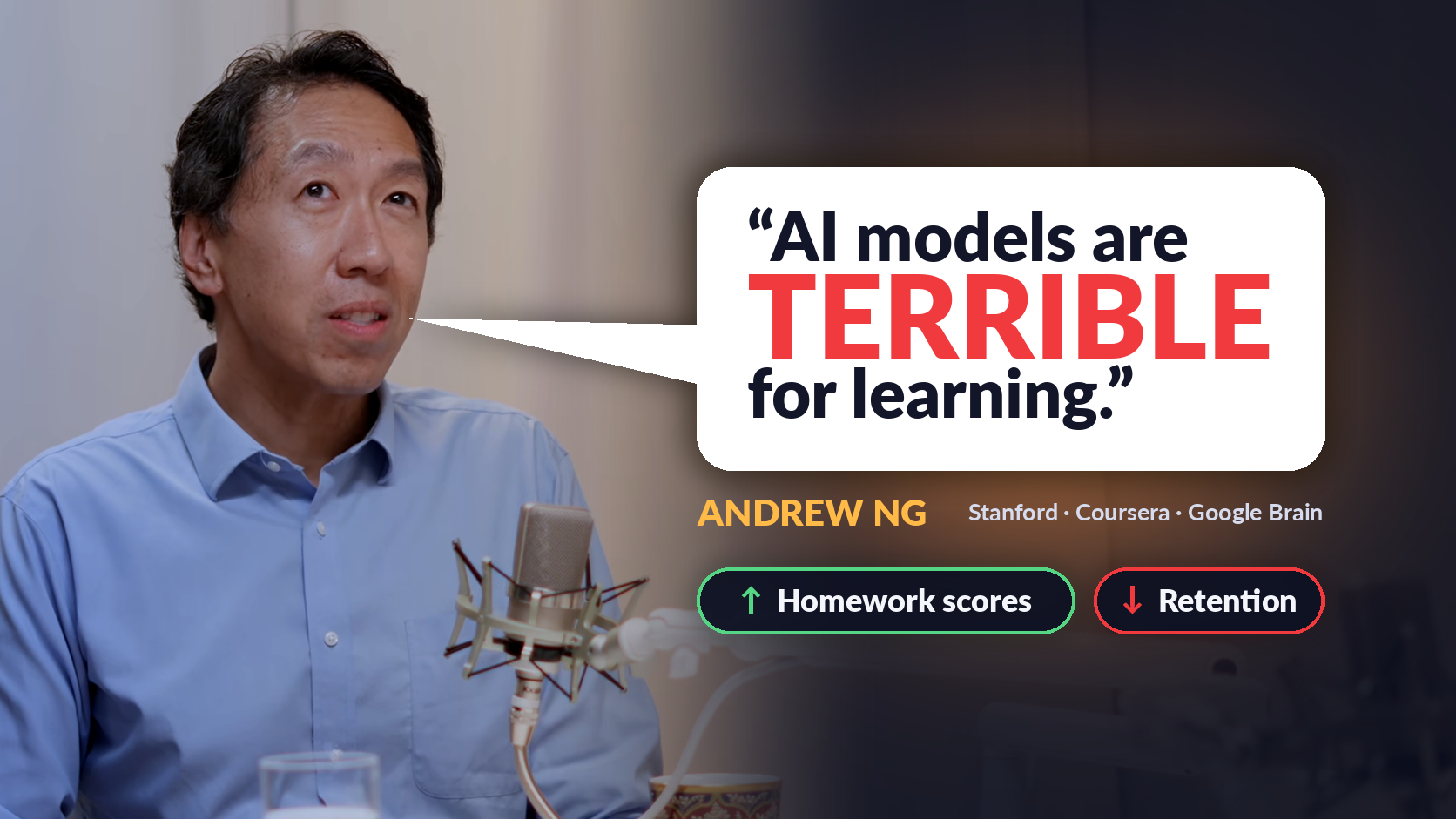
Andrew Ng is one of the best-known people in both AI and online education. He is an adjunct professor of computer science at Stanford, co-founded the Google Brain deep learning team, and was chief scientist at Baidu. He also co-founded Coursera, whose first big course was his own Stanford machine learning class, and he founded DeepLearning.AI, which teaches AI to millions of learners. Few people have done more to bring AI and education together.
In a recent interview on the Silicon Valley Girl podcast, Ng said something he expected to be controversial (14:04 in the video):
"I don't know if I've said this publicly: AI models are terrible for learning." (14:11)
He went on (14:39):
"Students score higher on homeworks when they use AI. Yay, higher homework scores. But retention, their long-term performance, is much worse, because the AI did the work for them and they didn't do it themselves."
That is a striking thing to hear from someone who has built his career on AI and on teaching it at scale, and who says he uses AI "all the time." It makes the point worth taking seriously.
That's the exact concern we've been raising. But I don't think the conclusion is that we need less AI in education. We need AI-powered learning tools that are built differently.
Completing an assignment is not the same as learning
Consider a student learning to program. Completing an assignment used to mean reading the problem, working out an algorithm, writing code, hitting errors, debugging, and trying again. That process was slow and often frustrating, and much of the learning happened in exactly those moments of difficulty.
Today the same student can paste the assignment into a chatbot and get a working solution in seconds. The tests pass and the grade is good. What the student learned is much less clear.
That opens a gap between what we measure and what students can do. Homework scores go up while independent problem-solving stays flat or gets worse. AI can improve the work a student submits without improving the student.
What the research shows
A field experiment published in PNAS, Generative AI without guardrails can harm learning, gave nearly a thousand high school math students access to GPT-4 during practice sessions. Students with a standard ChatGPT-style assistant did much better on the practice problems. On a later exam taken without AI, they scored 17% lower than students who never had access.
The researchers also tested a second version, a tutor prompted to give hints instead of answers. Those students also did better in practice, and on the exam they scored about the same as the control group. The harm went away.
So AI itself was not the problem. The problem was how it fit into the learning process: an assistant that hands over answers lets students skip the effort that produces learning.
A separate randomized trial with undergraduates, ChatGPT as a cognitive crutch, found the same pattern over a longer horizon. Students who studied with ChatGPT scored lower on a surprise retention test 45 days later than students who studied with traditional methods.
Neither study says that every use of AI harms learning. They suggest that tools designed to produce answers quickly can remove the effort that durable understanding depends on.
Flip the design goal
Most AI products are built to minimize the effort needed to finish a task. For work, that is usually what we want.
Education has a different goal. The point is not the correct answer. The point is a person who can produce the correct answer on their own.
So the question changes. Instead of "How can AI solve this problem for the student?" we should ask "How can AI set things up so the student has to solve it?"
AI can do a lot of that setup: generate many variations of a practice problem, adjust difficulty, run tests on attempts, spot common misconceptions, and give targeted feedback without handing over the solution. That is the work instructors rarely have time to do at scale.
The thinking itself stays with the student. Automate everything around learning, not the learning itself.
What we are building at CodeReps
This is the idea behind CodeReps. We started with programming, where the problem is most visible: AI writes working code so easily that take-home programming assignments no longer tell an instructor much about what a student understands.
The approach, which we described in an earlier post, is to make practice plentiful, make expectations public, and put independent assessment at the center:
- Instructors build a pool of programming problems, with AI helping to write variations, tests, and feedback.
- Students see the whole pool, know what they need to master, and can practice as much as they want.
- Assessment uses problems drawn at random from that pool and solved independently.
The goal is not to catch students using AI. It is to make real practice the most reliable way to succeed.
We are still building and testing this. The principle is simple: use AI to scale the teaching work, and keep the thinking in the student's head.
How we should judge educational AI
Ng's criticism matters because AI could do a great deal for education. We now have technology that can produce individual exercises, give instant feedback, and support students at a scale that used to require far more teaching staff. It would be a waste to use it mainly to help students skip the work that makes them learn.
Educational AI should not be judged by how fast students finish assignments or how high their AI-assisted homework scores are. It should be judged by what students can understand, remember, and do on their own afterward.
References
- Andrew Ng on the Silicon Valley Girl podcast, The Biggest Opportunities in AI Aren't Where You Think (YouTube). The quoted passage runs from 14:04 to about 14:45, within the chapter "Why AI Is Bad for Learning" (11:59). The same excerpt was posted as a short clip on Instagram.
- Bastani et al., Generative AI without guardrails can harm learning: Evidence from high school mathematics, PNAS (2025).
- Barcaui, ChatGPT as a cognitive crutch: Evidence from a randomized controlled trial on knowledge retention, Social Sciences & Humanities Open (2025).
Cover image: a still from the Silicon Valley Girl interview linked above.
Useful? It will be to a colleague too. Pass it on.